


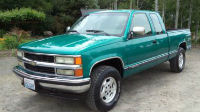
97 Chev 5.7L or transmission


Thread Starter
CF Beginner
Joined: Oct 2024
Posts: 2
Likes: 0
 97 Chev 5.7L or transmission
I have a 1997 Chev Silverado 1500 extended cab 2WD, 5.7L Vortec, with what I am told is the most common automatic transmission that came in it new. It has 206,000 miles and it was my daily driver for 12 years. My problem is that the transmission started not shifting to get over 20 MPH or so. I checked transmission fluid and it was full. Then I noticed that it would overheat very quickly, within 3/4 of a miles or so. And when I say overheat I mean the radiator was boiling over. I took it to an independent shop that I have used in the past and have always been satisfied with their work. They said that it sounds like I have a crack in a wall between 2 cylinders and that it is causing the transmission not to shift. They said will probably need another engine and possibly another transmission. Another shop said that it may be a blown head gasket due to oil being expelled on the driver's side of the motor. He also offered to buy the truck for $1200.00. Neither did any diagnostics. What do you think?

CF Pro Member


Joined: Mar 2024
Posts: 680
Likes: 105
From: Huntsville, AL
I replied to this already elsewhere, but will paste it here too... in the future, just pick one place to post your message!
First of all - failing to shift transmission gears is kinda unrelated to the supposed engine issues, in my opinion, unless the engine is maxing out its RPM or something, and not reaching the speed for shifting. The 4L60E was the most common transmission for many GM vehicles through those years, and I have it on both a 96 and a 2006 pickup, and had it on my 2003 Yukon.
I say that if neither shop did any diagnostics, they are both blowing smoke and don't know what they are talking about. Overheating that fast is serious and could lead to all sorts of failures, but would need an underlying cause, such as failed water pump, failed thermostat, clogged radiator, or something.
I agree that a crack between two cylinder walls will be a serious issue, but if the engine is running smoothly, I question that. I think it would be running like crap if that were the case, and shaking and acting seriously bad - not just refusing to shift or overheating.
A blown head gasket is certainly a possibility on these engines, but less serious and more likely than a cracked block or head. If the gasket blows out between two cylinders, it will act just like it would if there were a crack in the wall between those 2 cylinders, but with a crack, there would be more serious and catastrophic behavior I think. And you will likely have contaminated oil and/or coolant. I would look at both fluids carefully, and check the levels as well.
I've got a 1996 with a Vortec 5.0L, and have had the intake manifold gasket blow out not once but twice over the years. One time, it let to coolant and oil mixing. The second time, it led to all the coolant blowing out of the top of the engine. First time, I replaces the intake manifold gasket myself, and changed all the fluids. Second time I let a local non-dealer shop do the work for about $800 or so, and the underlying cause at that time turned out being a failed thermostat, leading to overheating and the blown intake manifold gasket. HOWEVER, I do seem to recall reading online that the early Vortec engines in the late 90's (96-98) had a reputation for blowing the intake manifold gasket.
I think I would seek a 3rd opinion, if you are not inclined to diagnose and repair this yourself.
First of all - failing to shift transmission gears is kinda unrelated to the supposed engine issues, in my opinion, unless the engine is maxing out its RPM or something, and not reaching the speed for shifting. The 4L60E was the most common transmission for many GM vehicles through those years, and I have it on both a 96 and a 2006 pickup, and had it on my 2003 Yukon.
I say that if neither shop did any diagnostics, they are both blowing smoke and don't know what they are talking about. Overheating that fast is serious and could lead to all sorts of failures, but would need an underlying cause, such as failed water pump, failed thermostat, clogged radiator, or something.
I agree that a crack between two cylinder walls will be a serious issue, but if the engine is running smoothly, I question that. I think it would be running like crap if that were the case, and shaking and acting seriously bad - not just refusing to shift or overheating.
A blown head gasket is certainly a possibility on these engines, but less serious and more likely than a cracked block or head. If the gasket blows out between two cylinders, it will act just like it would if there were a crack in the wall between those 2 cylinders, but with a crack, there would be more serious and catastrophic behavior I think. And you will likely have contaminated oil and/or coolant. I would look at both fluids carefully, and check the levels as well.
I've got a 1996 with a Vortec 5.0L, and have had the intake manifold gasket blow out not once but twice over the years. One time, it let to coolant and oil mixing. The second time, it led to all the coolant blowing out of the top of the engine. First time, I replaces the intake manifold gasket myself, and changed all the fluids. Second time I let a local non-dealer shop do the work for about $800 or so, and the underlying cause at that time turned out being a failed thermostat, leading to overheating and the blown intake manifold gasket. HOWEVER, I do seem to recall reading online that the early Vortec engines in the late 90's (96-98) had a reputation for blowing the intake manifold gasket.
I think I would seek a 3rd opinion, if you are not inclined to diagnose and repair this yourself.

Thread
Thread Starter
Forum
Replies
Last Post