


Help Needed With my '85 El Camino


Thread Starter
CF Beginner
Joined: Sep 2008
Posts: 5
Likes: 0
 Help Needed With my '85 El Camino
Hello Everyone,
I will say first and foremost that I am in no way, shape or form experienced in car repair. It is something that I am trying to learn for myself. I can not afford to go to the mechanic every time something goes wrong as my finances aren't what they used to be.
That stated I have a 1985 El Camino SS, the car only has 105k miles on it, it spent alot of time sitting in a garage. Recently it had been accelerating a little rough (more power/less power) and in the last week or so when I would park and remove the key from the ignition the car would chug for a few seconds before the engine finally cut off. Now it wont start.
The car turns over and over and over but it doesn't ignite. This has been an issue since I bought the car, I always had to pump the gas pedal before it would start if it had been sitting idle for any period of time. So I took off the Air filter and had a look at my carburetor. When I depress the pump that the gas pedal is linked to no fuel sprays into my carburetor. I do not smell gas when I press it.
Initially this led me to believe my fuel lines/filter/pump was clogged. So I got some starter spray and sprayed it into the carburetor to test it out. Sure enough the car fired right up immediately with the accelerant spray in there. So I began my inspection of the fuel line. First I removed the fuel line on the carburetor and checked my fuel filter. It was not clogged and it smelled of gasoline but there was no liquid gas on it, there was also no liquid gas in the carburetor. This led me to believe that it was my fuel pump as it didn't seem there was any pressure in the line.
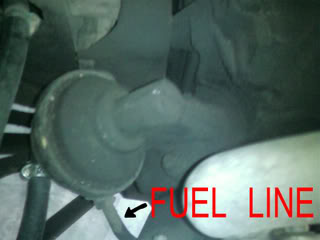
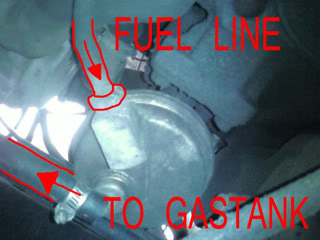
And here in lies my problem, I cant find the fuel pump. I followed the line down from the carburator (its a metal line not a hose) and it drops down the front of the engine and seems to be mounted here:
There is a hose connected to a metal line that enters here:
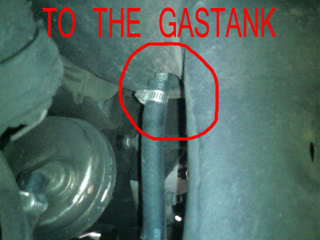
This metal line seems to run to the back of the car and into the gastank.....
If the first image is not the fuel pump then I dont know where it is unless it is inside the gastank?
I hope, with time, to rebuild this car peice by peice. I imagine that would give me a solid understanding of the vehicle and make it much easier for me to troubleshoot/repair in the future. The best knowledge is applied knowledge right?
Thanks for your help and your time,
Austin
I will say first and foremost that I am in no way, shape or form experienced in car repair. It is something that I am trying to learn for myself. I can not afford to go to the mechanic every time something goes wrong as my finances aren't what they used to be.
That stated I have a 1985 El Camino SS, the car only has 105k miles on it, it spent alot of time sitting in a garage. Recently it had been accelerating a little rough (more power/less power) and in the last week or so when I would park and remove the key from the ignition the car would chug for a few seconds before the engine finally cut off. Now it wont start.
The car turns over and over and over but it doesn't ignite. This has been an issue since I bought the car, I always had to pump the gas pedal before it would start if it had been sitting idle for any period of time. So I took off the Air filter and had a look at my carburetor. When I depress the pump that the gas pedal is linked to no fuel sprays into my carburetor. I do not smell gas when I press it.
Initially this led me to believe my fuel lines/filter/pump was clogged. So I got some starter spray and sprayed it into the carburetor to test it out. Sure enough the car fired right up immediately with the accelerant spray in there. So I began my inspection of the fuel line. First I removed the fuel line on the carburetor and checked my fuel filter. It was not clogged and it smelled of gasoline but there was no liquid gas on it, there was also no liquid gas in the carburetor. This led me to believe that it was my fuel pump as it didn't seem there was any pressure in the line.
And here in lies my problem, I cant find the fuel pump. I followed the line down from the carburator (its a metal line not a hose) and it drops down the front of the engine and seems to be mounted here:
There is a hose connected to a metal line that enters here:
This metal line seems to run to the back of the car and into the gastank.....
If the first image is not the fuel pump then I dont know where it is unless it is inside the gastank?
I hope, with time, to rebuild this car peice by peice. I imagine that would give me a solid understanding of the vehicle and make it much easier for me to troubleshoot/repair in the future. The best knowledge is applied knowledge right?
Thanks for your help and your time,
Austin
Thread Starter
CF Beginner
Joined: Sep 2008
Posts: 5
Likes: 0
RE: Help Needed With my '85 El Camino
Okay, so I am pretty sure that is the fuel pump now. After hunting around for parts on the net it looks just like the part in the pictures. So I guess my question now is, is there a way I can test and make sure my fuel pump is bad before replacing it? Any tips or advice on removing it?
Thanks,
Austin
Thanks,
Austin

CF Beginner
Joined: Aug 2008
Posts: 25
Likes: 0
From:
RE: Help Needed With my '85 El Camino
you are right that is your fuel pump in the picture my best advice to make shure it is bad is to disconnect the fuel line somewhere between the pump and the carb, have a friend turn the motor over and watch for fuel coming out. If there is no fuel make shure there is not a plug before your fuel pump you should disconnect the line and watch for fuel leaking out...assuming there is fuel in the gas tank, if you have no plugs in the line its time for a new pump.
When taking off your fuel pump there should be a bolt or at least a bolt hole just to the front of the block from the fuel pump you will want to tighten this (not too tight just snug) before removing the pump otherwise you will have to fight with the the plunger making the job that much more difficult. all in all not a difficult fix 2 bolts to remove it and disconnect 2 fuel lines and reverse... good luck
When taking off your fuel pump there should be a bolt or at least a bolt hole just to the front of the block from the fuel pump you will want to tighten this (not too tight just snug) before removing the pump otherwise you will have to fight with the the plunger making the job that much more difficult. all in all not a difficult fix 2 bolts to remove it and disconnect 2 fuel lines and reverse... good luck
Thread Starter
CF Beginner
Joined: Sep 2008
Posts: 5
Likes: 0
RE: Help Needed With my '85 El Camino
Thank you for taking the time to answer my question. I will check the lines in a bit and see if there is a clog. I am sure there is gas in the car....
So just to get this correct, if I disconnect the line at the carburetor and turn over the engine fuel would come out if the pump was good?
Also, if I disconnect the line from the tank to the fuel pump gas should come out, and if no gas comes out then there may be a clog in the tank/line? Do I need to have my friend try to start the car with the line removed from the pump in order for gas to flow through the line or should there be gas in there without the car on?
From what I can see the pump is connected with 4 bolts, but it is in a tight spot and I am sure its going to be fun to try to disconnect....
Thanks,
Austin
So just to get this correct, if I disconnect the line at the carburetor and turn over the engine fuel would come out if the pump was good?
Also, if I disconnect the line from the tank to the fuel pump gas should come out, and if no gas comes out then there may be a clog in the tank/line? Do I need to have my friend try to start the car with the line removed from the pump in order for gas to flow through the line or should there be gas in there without the car on?
From what I can see the pump is connected with 4 bolts, but it is in a tight spot and I am sure its going to be fun to try to disconnect....
Thanks,
Austin

CF Beginner
Joined: Aug 2008
Posts: 25
Likes: 0
From:
RE: Help Needed With my '85 El Camino
you dont need to turn it over when checking the lines between the tank and pump...if you forget about the plunger rod a pair of needle nose pliers seemed 2 work best for me, but it will fall out as soon as you pull out the pump. you will have to put it back up into the block with the needle nose pliers then screw the bolt into the hole to hold the rod in place. on my 350 the hole is the same bolt and hole for the ground wire but you will need a longer bolt... 1 of the bolts from the fuel pump should work fine. let us know how it goes
Thread Starter
CF Beginner
Joined: Sep 2008
Posts: 5
Likes: 0
RE: Help Needed With my '85 El Camino
Well, after all of my testing I isolated the problem to the fuel pump. I have absolutely no doubts in my mind now that it is the issue. I spent the last hour trying to get the nut from the fuel line off the pump. Its not happening. I soaked it in liquid wrench and let it sit for 30 minutes, tapped it to try to knock some of the gunky buildup loose. Still cant get it, and whats worse, the 5/8's wrench is stripping the nut, when it turn it it just bends the metal on the nut. I figure if I keep this up I may end up damaging the fuel line....
Austin
Austin
Trending Topics
Thread Starter
CF Beginner
Joined: Sep 2008
Posts: 5
Likes: 0
RE: Help Needed With my '85 El Camino
Alright, I cant get the darn thing off. Even if I get it off now the edges of the nut are so stripped I wouldn't want to use it again anyways. It seems trying to run a new fuel line from the pump to the carb could be a big hassle, as the metal line weaves behind the belts alongside the engine and drops down to the fuel pump. So what I am thinking is:
1. I cut the fuel line at the old pump and remove the pump
2. Remove the line from the carb and pull it out
3. Buy new fuel line connectors and install them on the new fuel pump and carb.
4. Run a braided hose from connector to connector, thereby eliminating the metal fuel line from pump to carb.
It seems to me that this would be much simpler to do than trying to install a new metal fuel line and will save me a major headache with trying to get this old fuel line off. The fuel line connectors are only like $8. Is there any reason I couldn't/shouldn't turn it into a braided hose system as opposed to the current metal line system? Seems to me it would simplify the whole process.... Thanks in advance for your input guys, and thanks for the help so far.
Austin
1. I cut the fuel line at the old pump and remove the pump
2. Remove the line from the carb and pull it out
3. Buy new fuel line connectors and install them on the new fuel pump and carb.
4. Run a braided hose from connector to connector, thereby eliminating the metal fuel line from pump to carb.
It seems to me that this would be much simpler to do than trying to install a new metal fuel line and will save me a major headache with trying to get this old fuel line off. The fuel line connectors are only like $8. Is there any reason I couldn't/shouldn't turn it into a braided hose system as opposed to the current metal line system? Seems to me it would simplify the whole process.... Thanks in advance for your input guys, and thanks for the help so far.
Austin

Thread
Thread Starter
Forum
Replies
Last Post
amdavis15
Chevelle & El Camino
1
Jan 27, 2016 11:21 AM
