


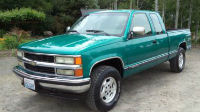
1994 chevy silverado C1500 5.7L/ A/C problem


Thread Starter
CF Junior Member
Joined: Jun 2021
Posts: 76
Likes: 14
 1994 chevy silverado C1500 5.7L/ A/C problem
Well, I finally got back to this truck to replace the condenser that had a few leaks on it. I replaced the condenser which came with its own orifice tube. I did not replace the accumulator because I had just put in a new one when I replaced the refrigerant hoses. I started to put in the 12 oz cans of refrigerant and after I put in the first 12 oz, the clutch still will not engage. I don't want to put anymore until I get some professional help from you guys here. When I turn the A/C on, the ac relay which is behind the glove box, I can hear the relay click so the relay should be ok. I was thinking that one can should be enough to get the clutch to engage but not sure. Do any of you have a trouble chart on the air conditioning system on this truck that I can get from you so I can troubleshoot and hopefully find the problem. After replacing the condenser and before I started to charge the system, I did a vacuum down first. Thanks for your help as always.

CF Veteran

Joined: May 2011
Posts: 1,578
Likes: 302
From: Central Iowa
If the capacity I found is correct (check the under hood sticker to verify), the system should hold 32 oz of refrigerant.
12 oz is only about 1/3 the system capacity - it probably needs to be charged to at least 1/2 capacity before the low pressure switch will close.
Try adding another can. If it doesn’t engage, try jumping the low pressure switch.
If it still doesn’t engage, try jumping the switch side of the relay to verify the clutch circuit is in tact.
12 oz is only about 1/3 the system capacity - it probably needs to be charged to at least 1/2 capacity before the low pressure switch will close.
Try adding another can. If it doesn’t engage, try jumping the low pressure switch.
If it still doesn’t engage, try jumping the switch side of the relay to verify the clutch circuit is in tact.
Thread Starter
CF Junior Member
Joined: Jun 2021
Posts: 76
Likes: 14
Thanks to both of you for your help. I connected the gauges this morning and there is only about 10psi pressure showing on the low side and 0 on the high side. I checked the low pressure switch with my multimeter and the switch has continuity so it should be ok. I also checked the switch behind the compressor ( don't know the name of it) and it also has continuity. I checked the voltage at the low pressure switch and with key on, it shows 12 volts on one wire and 0 at the other wire. I removed the connector of the low pressure switch and put a jumper on it and the clutch will engage. It must really be low on refrigerant because if I depress the schrader valve, there is very little pressure at all. Would it be ok to go ahead and jump the low pressure switch to engage the clutch and add refrigerant that way or can damage be done to components since the switch is a low pressure monitor. Or, is it better to leave the low pressure switch connected and just add 12 volts to the clutch coil to get it to engage. one final question, when I first connect the gauges to the system, with couplers at the close position and the manifold valves closed, should the gauge read ambient temperature or not. If I am not mistaken, when I hooked them up to my other car, the gauges were reading about 75psi on both low and high side and the ambient temp. was at about 76 degrees.
CF Veteran
Joined: May 2011
Posts: 1,578
Likes: 302
From: Central Iowa
You can jump the low pressure switch however, do not allow the compressor to engage for more than 1 second at a time. Add more R134a in between clutch engagements.
The refrigerant is what circulates the oil through the system. If you run it for too long with too low of a charge, the compressor won’t get adequate lubrication and will most likely seize, if not fail in some other way.
For a fully charged system, static pressure (engine cold and not running) should reflect ambient temperature when it’s between approximately 20 to 80 degrees Fahrenheit on both sides of the system. Above or below that range will require experienced discernment as to whether or not the static pressure is adequate.
If the system is low on charge, or overcharged, the static pressure will depend more so on the charge level.
The refrigerant is what circulates the oil through the system. If you run it for too long with too low of a charge, the compressor won’t get adequate lubrication and will most likely seize, if not fail in some other way.
For a fully charged system, static pressure (engine cold and not running) should reflect ambient temperature when it’s between approximately 20 to 80 degrees Fahrenheit on both sides of the system. Above or below that range will require experienced discernment as to whether or not the static pressure is adequate.
If the system is low on charge, or overcharged, the static pressure will depend more so on the charge level.
Thanks to both of you for your help. I connected the gauges this morning and there is only about 10psi pressure showing on the low side and 0 on the high side. I checked the low pressure switch with my multimeter and the switch has continuity so it should be ok. I also checked the switch behind the compressor ( don't know the name of it) and it also has continuity. I checked the voltage at the low pressure switch and with key on, it shows 12 volts on one wire and 0 at the other wire. I removed the connector of the low pressure switch and put a jumper on it and the clutch will engage. It must really be low on refrigerant because if I depress the schrader valve, there is very little pressure at all. Would it be ok to go ahead and jump the low pressure switch to engage the clutch and add refrigerant that way or can damage be done to components since the switch is a low pressure monitor. Or, is it better to leave the low pressure switch connected and just add 12 volts to the clutch coil to get it to engage. one final question, when I first connect the gauges to the system, with couplers at the close position and the manifold valves closed, should the gauge read ambient temperature or not. If I am not mistaken, when I hooked them up to my other car, the gauges were reading about 75psi on both low and high side and the ambient temp. was at about 76 degrees.

CF Monarch
Joined: Oct 2017
Posts: 4,605
Likes: 269
From: USA
I cant add more then what Gumby22 has informed you of Birdman. Just go slow and wear protective eyewear, and perhaps some leather gloves, as refrigerant can get real cold on bare skin. Hopefully, that will not occur at all.
Trending Topics
CF Veteran
Joined: May 2011
Posts: 1,578
Likes: 302
From: Central Iowa
That’s good advice - I often forget to mention PPE.
Thread Starter
CF Junior Member
Joined: Jun 2021
Posts: 76
Likes: 14
Thanks Guys. Good advice. I have a question . I see on some videos that when you are charging the A C system with 12 oz cans, they turn the can upside down to let the gas or liquid go in and than I hear other persons say that it is a very dangerous thing to do. What do think about this? Also, on the self sealing cans, when you put the can tap on the can, you turn the valve all the way down to open the seal to release the gas. At this point, do you keep the valve down all the time you are charging the system or do you bring the valve up slightly? Just want to make sure.
CF Monarch
Joined: Oct 2017
Posts: 4,605
Likes: 269
From: USA
Thanks Guys. Good advice. I have a question . I see on some videos that when you are charging the A C system with 12 oz cans, they turn the can upside down to let the gas or liquid go in and than I hear other persons say that it is a very dangerous thing to do. What do think about this? Also, on the self sealing cans, when you put the can tap on the can, you turn the valve all the way down to open the seal to release the gas. At this point, do you keep the valve down all the time you are charging the system or do you bring the valve up slightly? Just want to make sure.
I dont like to add too much refrigerant too fast, as that can damage some more "delicate" A/C Compressors valves, but usually not the with the first can. Keep your eyes on the gauge set and try to keep it slow and steady. If you have to run a can through with a pumped-out system, you should be able to do that as you want enough pressure to get the low-pressure sensor working so the A/C Compressor will run while adding another can.
I just bypass it myself and run the compressor after a can, turning on the A/C switch in the unit with the temp **** set as low as it goes. I dont worry about weight as two cans of R-134A should do it unless you have a Suburban, then you are looking at three cans. I dont work on second evaporator units, so not an issue at all.